
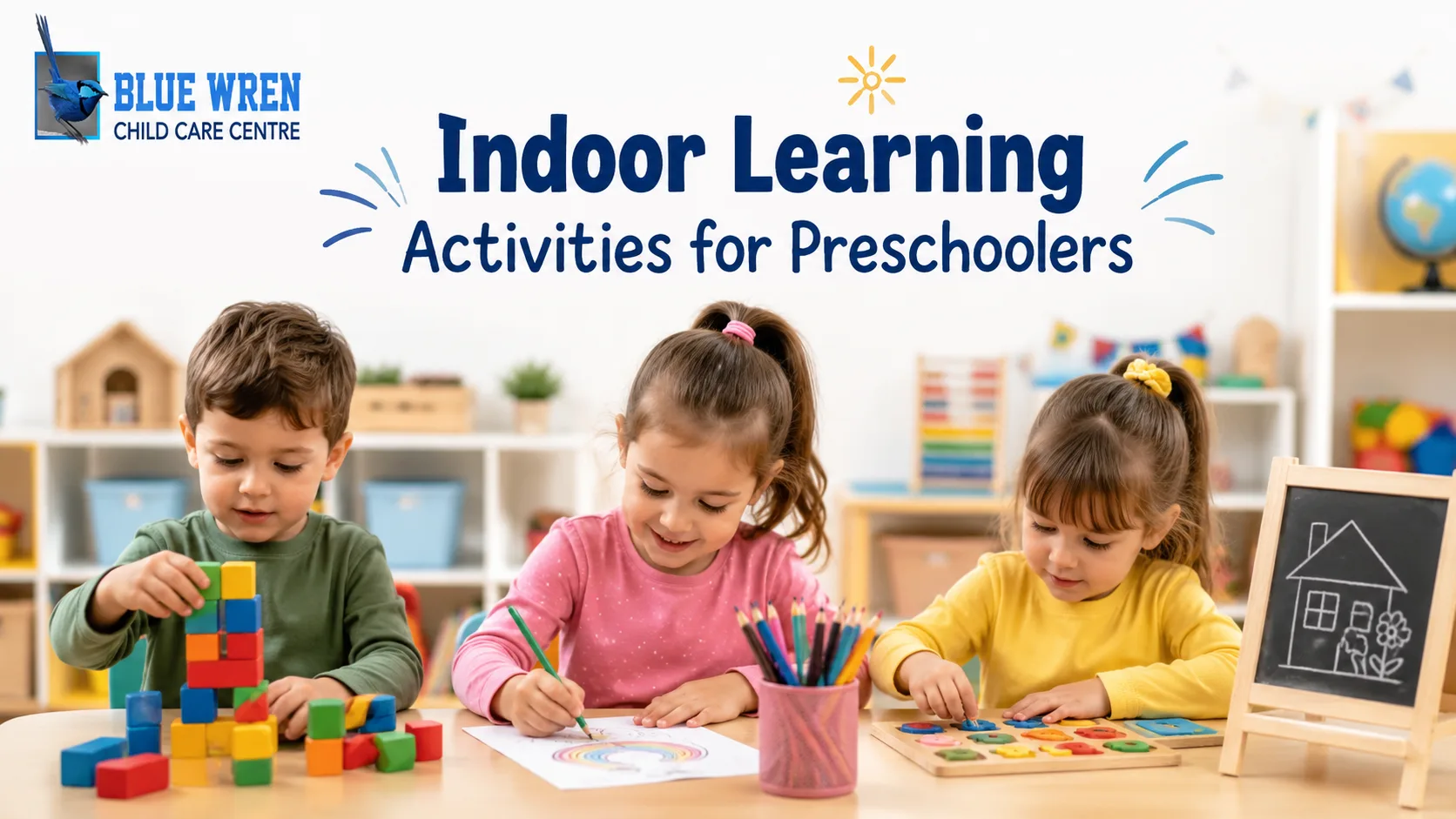
Preschoolers develop well only when they get to touch, play and ask. At the same time, indoor activities can change regular surroundings into a source of learning. Moreover, they allow children to develop important skills in a playful way. Parents and teachers can provide their children with various activities without spending much money.
Children should be allowed to develop skills connected to language acquisition, thinking, physical development, social interaction and creativity. Having one activity, children can acquire several skills at once. Most early learning centres utilise unstructured as well as structured activities to provide opportunities for children to learn through experiences in their everyday environment.
#1. Storytelling and Picture Books
Telling tales is a straightforward way to improve language abilities. Pick vivid picture stories that are suitable for your kid’s age and interests. Pose queries about the individuals in the book and illustrations. Help your kids to illustrate what they see in the pictures. You can let them guess what will occur next after showing the pictures. This promotes vocabulary building, listening skills and the power of expression. After reading the book, you can prompt children to recite the story in their own words.
#2. Indoor Treasure Hunts
Treasure hunting is an enjoyable way of learning. You can conceal harmless objects all over the room. Provide kids with easy hints and clues to help them discover the objects. The clues can involve things like colours, shapes, numbers, or letters; for instance, you can ask your child to find a blue-coloured object or to find three round ones. This activity enhances children’s skills of observation and decision-making.
#3. Building With Blocks
Blocks offer tremendous scope for innovative learning. Children can form buildings, towers, bridges and other creations. They learn concepts of balance, size, shape and space while playing. Challenge the children to build a tower of five blocks, followed by another one of ten blocks. This simple challenge introduces concepts of mathematics at an early stage. It also helps children develop their coordination. Examples of activities of this nature may be found in play-based learning childcare centres providing education through play rather than through memorising the material being taught.
#4. Sorting and Matching Games
Sorting games enable kids to see both similarities and differences. Children should be given objects of different shapes, sizes, and colours and be asked to group similar objects in one place. They may use toys, buttons, building blocks, or home belongings. Make sure that the items are always safe and suitable for the child’s age. While doing this activity, the teacher might ask questions like why two things are put into one group. Such games provide a perfect introduction to basic mathematical concepts and enhance logical thinking and the ability to concentrate.
#5. Arts and Craft
Arts and crafts provide children with an opportunity to express their creativity. Have on-hand paper, crayons, washable paint, and safe crafty supplies for them. Encourage them to use their imagination freely. Do not concentrate too much on the result. It is important to stimulate children to use different colours and materials. Ask them questions about their creations. This method of teaching improves their communication and creativity.
#6. Indoor Music and Movement
Music has the power to motivate children to move, listen, and react. It’s great to play simple songs encouraging them to dance, clap, or march. Action songs that involve stretching or jumping can also be a good choice. You can use the freeze game using music. Let your little ones move around while the music plays. Once you stop the music, tell them to freeze. This exercise helps children learn how to listen and control their bodies, while movement helps them spend energy.
#7. Simple Science Experiment
Little children love figuring out the way things work. Simple science experiment ideas that will encourage their curiosity: Have them play with water, magnets, ice, or household items. Take a container, fill it with water, give some objects which are safe, and ask children what items they think will float in water. Give the children a chance to test some of their assumptions. Talk with the kids about the results of their experiments. The tests should be kept simple, and all of the kids watched carefully. The aim is to inspire kids to ask questions and make observations.
#8. Pretend Play
Make-believe play enables kids to learn about their environment. Choose a simple shop, cooking area, doctor’s office or school. Make sure kids play different characters. Role-play allows kindergarteners to talk with each other, argue and try out new words. Role play is also helpful in the development of social and emotional skills. Role-play activities in early learning centres can also promote social and emotional development in children, as they provide a comfortable way for children to explore different scenarios.
#9. Puzzles and Memory Games
Puzzles support the cognitive development of kids. Choose a puzzle according to the child’s age and capability. Then, increase the level of difficulty over time. Memory games are also very useful. For this game, show some known items in front of the child. Allow the child to look at them for a few moments. Cover the objects and take one object away. Ask the child to tell what object was taken away.
#10. Letter and Number Games
Start teaching young children the fundamentals of reading and number skills through fun games. Write the alphabet letters down on some cards and ask the children to point out the letters that you wrote. You may also associate objects with letters of the alphabet. In terms of numbers, count all the toys and blocks and other everyday objects together with the child. Ask the child to hand you the exact number of things. Keep the activity short and interesting. A facility that focuses on play-based learning childcare centre can incorporate these games into stories, movements, and crafty activities.
Choosing the Right Learning Environment
Indoor activities are effective when children are comfortable with having their needs met. Adults should allow children the freedom to explore while giving them assistance when there is a problem. If you are seeking a kindergarten in Hawkesbury, you may like to enquire about how the kindergarten focuses on teaching and learning styles. Seek out centres that encourage creativity, open communication, movement and autonomy.
Learning needs to be done in the right environment. Children should get a chance to use various materials and tasks every day. Parents can set up their home learning area with ease. Just get a small table with some books, art supplies, games, and a few blocks and your kids will be entertained for hours!
Conclusion
The process of learning indoors doesn’t necessarily imply that the process of teaching is formal. Simple games can help children learn vital skills in preschool. Storytelling promotes language understanding. Playing with blocks enables solving puzzles. Art helps in developing creativity. Music encourages movement and listening skills.
Children who learn through fun activities become more curious and confident. The options for quality kindergarten in Hawkesbury area can also be investigated.
The key is to organise appropriate activities for all ages. Allow children some time to learn on their own. Ask them questions. Listen to the answers. A good approach can turn any indoor entertainment into effective learning.