
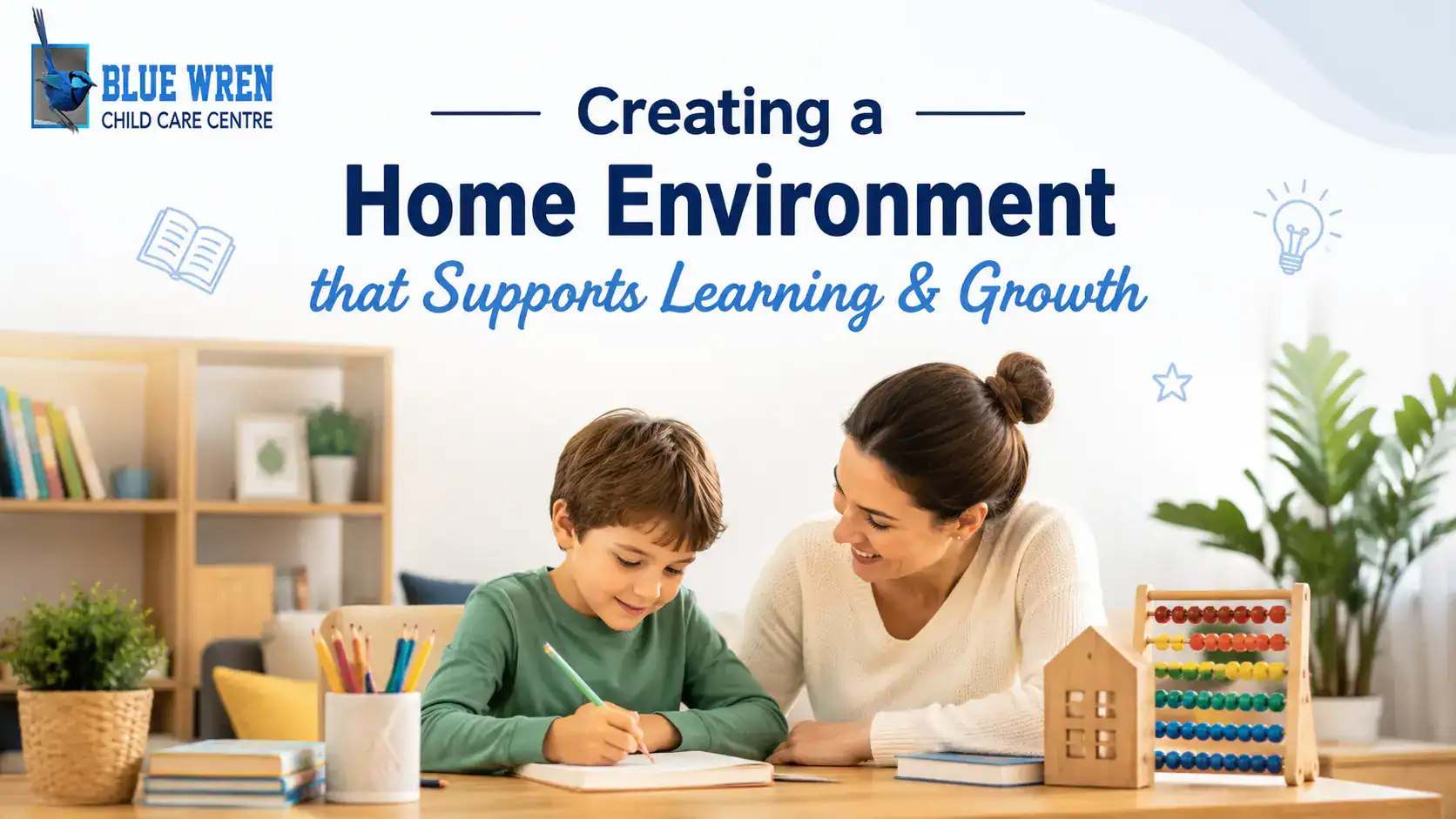
All children learn through their daily experiences. Early learning centres do help in development, but families significantly shape children, too. Children spend a good amount of time with their families, so the home becomes the first place for exploration, questioning and confidence building. A positive environment leads to curiosity and development of relations and life skills.
Parents do not require expensive resources and the most sophisticated playrooms to enable kids’ learning. In fact, daily activities help in encouraging creativity, communication, and independent thinking. Integrating learning into daily life makes it all fun and easy.
Create a Safe and Inviting Learning Space
Youngsters are most likely to learn effectively in an atmosphere that makes them feel secure and safe. You should create an area where your child can undertake reading, drawing, construction activities, and simple tasks undisturbed. It does not have to be a vast space. A couple of items, such as a table, bookshelf, and a few learning materials, will suffice.
The books, puzzles, art materials, and construction kits should be placed where the interested young mind can easily access them. Toys and activities should be varied in order to avoid boredom. At many early learning centres, it is important that children experience the fun of learning and possess independence in such matters.
Encourage Learning Through Play
Through play, children acquire skills effectively. Children learn to speak, think, invent, and interact with others. Play helps children develop their decision-making and problem-solving abilities and express feelings.
Even an easy activity can change a lot. Make a tower of blocks, build a shop, or solve puzzles together. All those activities strengthen learning and family ties. Many play-based learning childcare centres that use the approach have hands-on activities because children get a better understanding of concepts when they can take part in the process rather than just watch.
Make Reading a Daily Habit
Reading with your children everyday can promote creativity, improve listening skills, enhance vocabulary, and boost their language skills. Picking stories in accordance with children’s interests lets them ask questions.
Mentioning images, talking about characters, and making predictions is part of the process that makes reading that keeps children interested and using their critical thinking skills. You can also implement family reading practice – spend 15-20 minutes with books before going to bed.
Include Children in Everyday Activities
Daily activities are filled with chances for learning. Children can be invited to help in meal preparation, grocery shopping, laundry sorting, and plant watering. These activities teach kids responsibility while introducing them to mathematics and science.
Cooking also teaches kids about counting, measuring ingredients, and following recipes. Gardening provides patience and knowledge about the natural world. Setting the table is another way to teach kids. Lessons learned through practical experience are usually easier to remember.
Support Curiosity and Questions
Children are curious beings who have many questions in their minds. Rather than giving them the information they need every time, we can help them find answers by asking questions such as, “What do you think will happen next?” or “How can we get there best?”
We will prepare our kids for independent learning by teaching them critical thinking skills. Asking questions will help the child to develop the idea of lifelong learning.
Balance Structure with Flexibility
Children benefit from routines. Routines help to create order and reduce uncertainties. Establishing a consistent routine helps children know what to expect each day. This will assist your child’s day to run smoothly.
However, make sure to leave some room for unplanned plays. Your child may take an interest in painting, building or collecting insects on certain days. Following their interests makes learning fun and meaningful.
Home learning can also be more flexible than traditional learning centres, which means that they usually do more structured teaching.
Limit Screen Time and Encourage Interaction
Digital gadgets have the ability to enhance education, but they should not substitute for hands-on activities. Thus, parents should promote active pursuits such as walking, chatting, using one’s creativity, and exploring.
Board games, discussing topics with family members, travelling, listening to music, or doing crafts can help develop important skills in children. These activities boost communication skills and strengthen family ties.
Young children who chat with people rather than gadgets naturally build social and emotional maturity in parallel with academics.
Celebrate Effort Instead of Perfection
Confidence for children is won not with results, but with parents’ recognition of trying. It’s about the acknowledgement of commitment, problem-solving skills and cleverness that is required. Noting positive wins like a child discovering a new word, a child cracking a puzzle, and a child taking on an unfamiliar task.
Mistakes play their own role for education. Children have to be taught to perceive failures as steps in education. Providing affirmative encouragement is conducive to the development of resilience and the motivation to learn.
Work Together with Educators
Parents and educators work together to reach the goal of promoting the development of children. One of the things that parents can do is stay in touch with educators and find out what things the children are currently studying at school so they could do the same things at home.
Several play-based learning childcare centres that focus on learning through play offer parents ideas for continuing the work at home. By relating home activities to what children learn at daycare, parents might make the process of education more consistent.
Focus on Lifelong Learning
Parents have many ways to ensure the family creates a home that will foster curiosity, encourage independence and provide opportunities for growth. Daily meaningful conversations, reading, imaginative play, and other learning activities lead to a happy and healthy growth of children.
Though the centres of traditional learning centres will continue doing their important work to formulate children’s basic skills and knowledge, it is the sum total of all those experiences along with a supportive and positive family learning environment that leads to maximum benefit for children.