
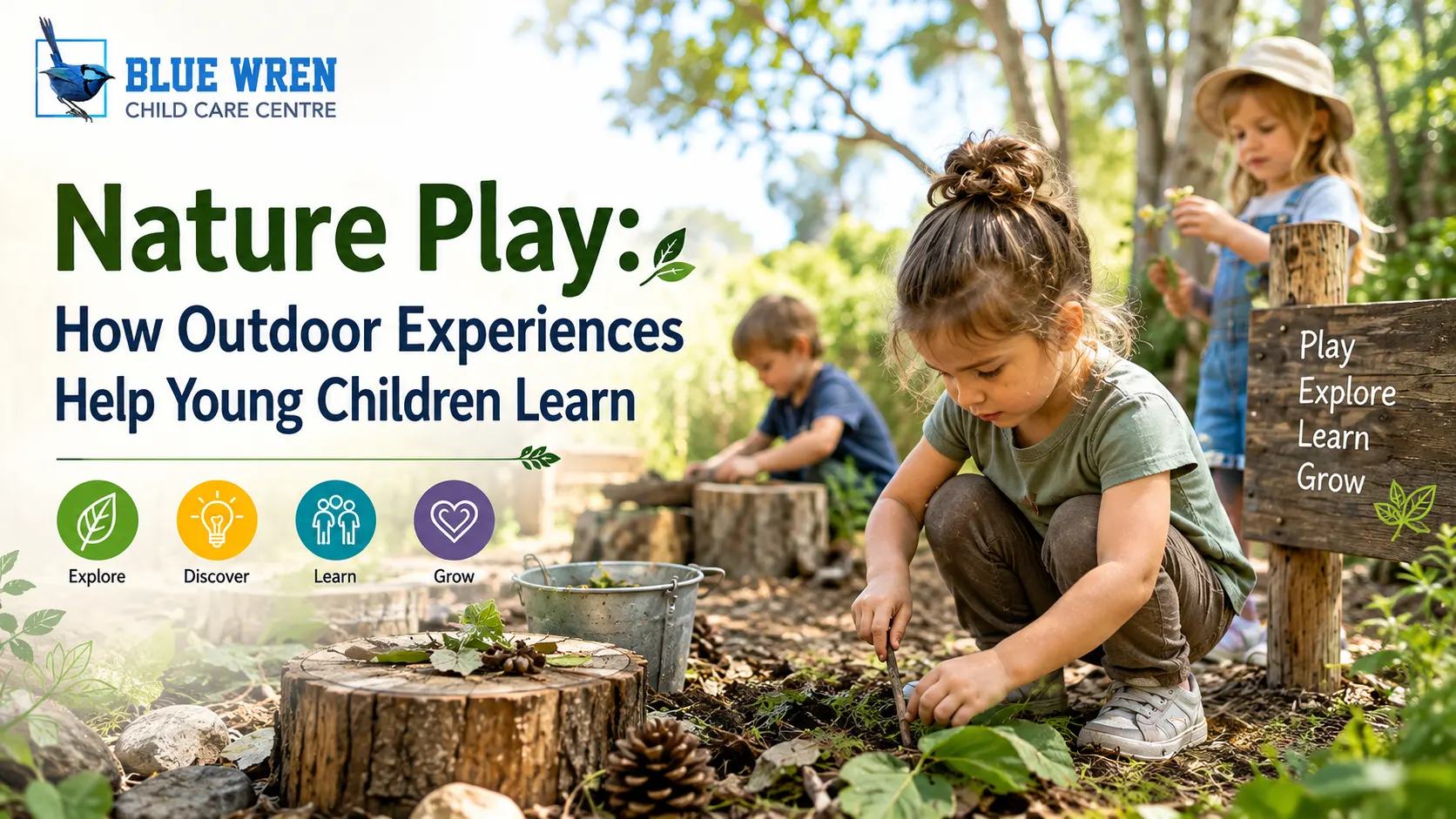
They learn from everything other than books, toys and even when they are in class. By feeling the mud, observing the bugs, collecting the leaves and running around in the open, they learn with the help of nature. Nature is the best teacher, as it provides the children complete freedom to learn in their own style by instilling the innate desire to explore and learn. For example, a walk in the garden can ask the questions of how different and why different leaves are found and why some, as compared to others, smell different, how a bird builds its nest, and all such natural observations and queries in one’s mind et al.
Learn through Exploration
Outdoor learning offers children many opportunities to explore and play. In nature, children can pick up a stone, look at flowers, listen to birds and watch for insects. All of these examples will introduce new language and ideas. Children are also able to learn through their own initiatives. They can choose where they walk, what they look for and how they play with the natural materials.
However, this natural learning can be encouraged in a play-based learning childcare centre. In outdoor learning, a teacher can offer the child a range of simple ideas that can be explored in many ways and that do not limit the child’s freedom. For example, teachers could ask children to locate two or more objects of different shape or colour, count sticks or leaves, observe differences between rocks or listen to and describe their observations.
Supporting Physical Development
Where they can stretch their limbs. Here they can run, jump, climb, balance, crawl and throw. These all develop strength, co-ordination, body control and body confidence. When you move and play outside, you become much more confident.
You might be hesitant when you try to climb up a small tree or piece of play equipment for the first time, but with practice you learn to manoeuvre your body in different ways – to balance, to move safely and to reach the top to get the best view from the top. Natural spaces offer a different physical environment where you need to ‘pick your way’ along uneven paths, climb over or run around fallen branches and up hills.
Building Problem-Solving Skills
Nature can create challenges that children can solve through trial and error. They could want to cross a muddy space without getting soggy or create a hide from sticks or figure out how to shift a large stone. These kinds of situations promote thinking and troubleshooting.
Children might have a go at one thing, see what happens and then have another go at something different. You can support this by asking open-ended questions, rather than giving the answer by asking, ‘What can we try?’ or ‘What do you think might happen?’ This enables children to build up an idea of what they can do to try and solve problems.
Encouraging Social Learning
Playing together outdoors Playing together is a great reason to play outside. The children form their own games and construct things as a team. They will also negotiate, share equipment and communicate their thinking to other children. They might have to agree on who will go and collect sticks or take turns to construct the campsite.
These little interactions are important for children’s development of co-operation, patience, listening and negotiation. early learning centres can make the most of their outdoor space by planning for group activities alongside free play. Gardens, nature walks and building activities all provide opportunities for children to work as a team.
Connecting Children with the Natural World
Time outdoors is a great way to nurture a child’s natural bond with the outdoors. By giving children an opportunity to care for plants or observe small creatures, they start to see how living things are affected by the environment: “Water is good for plants, and clear water is better for animals. Some birds are more active in certain weather conditions.” These fun observations are the foundation of science. Caring for their environment – cleaning up when they see trash, watering plants, and protecting a tiny patch of ground from damage – can be reinforced through these simple actions.
Supporting Emotional Well-Being
Taking play outside can be a way for children to be active, to explore and to relax away from structured activities. Wide-open spaces can also be a place to have a quiet moment. A child might sit under a tree and watch the clouds go past.
Another child might want to dig in the dirt by themselves. This can mean children can choose the types of play that suit what they are interested in and how much energy they want to use. Childcare centres can have a variety of spaces, including outdoor ones where children can move between active and quiet play.
Making Nature Play Part of Everyday Learning
Get outdoors without the need of a costly outdoor area. At an early learning centre, the outside space can be the garden, the yard, the park, or a safe outdoor space. Even a small space is enough for children to discover and explore if there is time and room to do so. Grownups can offer support when children need guidance but then step back and follow where the child leads the way. A play-based learning childcare centre allows nature to be woven into the daily experience, enabling children to engage in nature play on a regular basis.
Outdoor learning doesn’t need to be a special event or activity for an early learning centre. It can simply be something that is part of the routine, the daily rhythm of the morning checklist or a short walk around the block. Kids can sit with a basket of natural objects to explore and delight in. The same process applies equally to other childcare centres.
Nature play teaches children that learning occurs in all kinds of places. An area of grass can be a science experiment. A bunch of sticks can be a building site. Going for a walk outside can lead to questions, discussion, motion and wonder. As children have more frequent opportunities to explore nature, they learn new skills and have fun doing so. They learn to ask questions, find solutions, play with other people and gain confidence. And above all, they learn that there’s a world of wonder out there.