
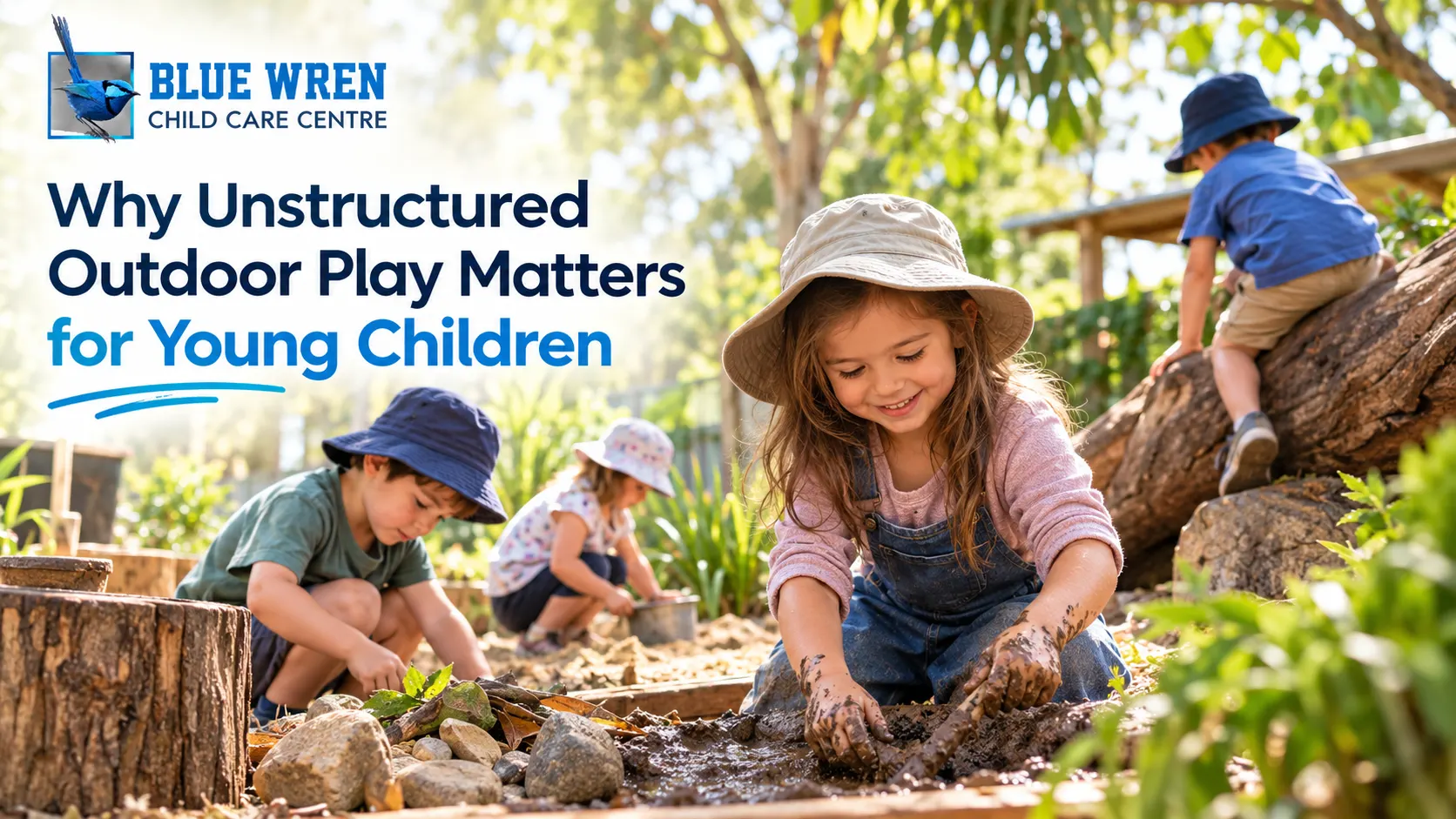
Young children need time to play without instructions. Unstructured outdoor play gives them that freedom. It allows children to explore, move, imagine and make their own choices. They can turn a simple stick into a wand or a patch of sand into a pretend kitchen. This type of playsupports more than physical activity; it also helps children develop social, emotional, cognitive and creative skills. When adults provide a safe environment and allow children to lead their play, they create valuable opportunities for natural learning.
What Is Unstructured Outdoor Play?
Children require time to have fun without being told how to do it. Unstructured outdoor play provides this opportunity for the child, as it permits them to move, think, and act as they like. A child’s imagination can quickly turn a piece of wood into a sword. Children doing this type of play gain not only the benefits of physical activity, but they also obtain important social, emotional, cognitive and creative skills. Adults creating opportunities for children to play usually lead to important learning experiences for them.
It Builds Physical Skills
Moving in nature is a part of children’s day. Kids are jumping, climbing, crawling and throwing. Those movements develop respectively strength and coordination. Childcare centres can set up safe outdoor spaces that allow children to practise these movements on a daily basis. Being active outside also helps improve body awareness. Regular movement in nature also contributes to body awareness. Children understand distance as well as they are learning to control movements and manage balance. E.g., while moving along an obstacle, a child needs to decide where to put their hands and feet.
It Encourages Creativity
Outdoor activities provide infinite opportunities for creative thinking. A child doesn’t need costly toys to get involved in a fun game. Just using a few twigs, a child can build whatever he/she would like. Leaves can be transformed into imaginary food. Stones can act as counters for the game. Kids are free to come up with their story and rules. Their thinking is constantly tested and altered during the game.
It Supports Social Development
Yesterday, children frequently engaged in outdoor play. They communicated their rules, exchanged their games and talked about how to run the game. There may be disagreement over the owner of the particular toy or disagreement regarding the place to build something. Such moments allow children to learn communication and cooperation skills. Childcare centres have the potential to encourage such experiences by providing children with opportunities to play and engage with their peers. They also are taught that people can have different opinions. Parents can help their kids during this process without controlling their every interaction. A simple question can help children analyse the conflict and solve it by themselves.
It Helps Children Become More Independent
Playing freely allows an individual to make choices. The choices that children make may be about where to play, what tools to use or how to face the obstacles. Small as it may seem, each choice leads kids to be more determined. Furthermore, children get valuable experience from their mistakes. They might build a tower that collapses, or have a game that does not go as planned, or try climbing and fail. Instead of solving the problem right away, adults should give their kids a chance to do it by themselves, which will teach them to persevere and arrive at a solution on their own.
Nature Adds Another Layer of Learning
Playing outside allows kids to learn more about nature because they will notice weather changes, see insects, feel various textures, and so on. Such experiences will generate interest in many things. Kids may, for example, frequently wonder why leaves change their colour or where ants go. The questions asked by kids can provide opportunities for new knowledge for them. Adults would either give kids certain explanations or cause their curiosity as well. It is important to note that nature does keep on changing, which will provide kids with new things to notice in different seasons of the year.
How Childcare Settings Can Support It
Good outdoor learning spaces do not have to be designed to perfection. They should simply provide children with opportunities to learn, play and discover on their own. Many early learning centres already have open-ended learning materials, including sand, water, blocks, natural objects and other loose parts that spark imagination in children. A playbased learning childcare centre can guarantee a successful experience in education. It is more important for teachers to observe children rather than interfere with their activities. Various outdoor zones at a learning centre may also be closed off in case a child is bored and prefers more quiet activities such as drawing, watching animals or making a conversation with a friend.
Creating the Right Balance
Structured learning continues to play a significant role in early education. Children learn from organised activities, lessons, stories, and other organised experiences. However, children also need periods of unguided time. Early learning centres can find the right balance by mixing structured learning with free playtime outdoors. That way, children can develop skills without sacrificing their interests. A learning centre can use the outdoor environment to extend the learning process. Teachers keep track of what children are interested in and make plans accordingly. Another great thing a playbased learning childcare centre can do for children is to facilitate outdoor play.
Giving Children Time to Explore
From an adult’s point of view, unstructured play for children outdoors seems fairly straightforward. A child running around in a field or picking rocks seems unrelated to any learning objectives. But still, learning takes place here. Children move about, engage with others, make decisions, and solve different kinds of problems, and it is all part of the learning process. Adults should not try to convert any outdoor play into a lesson. Instead, adults should create safe spaces for children to learn by themselves. Children will be able to learn naturally through the learning process if they get enough time, place, and freedom to play.